Wednesday, October 17, 2012

More surprises

As the tour of this place was finishing up, we walked out of the amphitheater inside of the mountain, to discover an entire recreated street of old Guanajuato three stories below the first floor. The owner of the house, I still stumble over that word, but can't find a better one, built this street in honor of his father who was governor of Guanajuato in the 60's. There are fully stocked shops, another bar and a huge kitchen. We were invited into the bar where there were tables set up with fabulous cheeses, meats, a variety of breads, and beautiful fresh fruits, along with wine, water or soft drinks.

I enjoyed the repast, not understanding that a huge banquet was still to be served out on the "street."

gambling - still inside the train

stage with natural stone striations

amphitheater leading out to the "street"

a part of the reconstructed whole block of old Guanajuato

bar and restaurant on the "street"

one of the meat and cheese trays

more fabulous food
John by the pool with one of his sculptures

Another pool sculpture

The owner, showing us an antique shoe that was used for removing corn from the husk


Sign on the street with the years that the father was governor of the Guanajuato
There was so much to see, and take in. The energy of everything stayed with me and woke me in the middle of the night, still amazed.

Monday, October 15, 2012

Emerging from the inside of the moutain

2 Pullman coaches that belonged to ex-president of Mexico, Porfinio Diaz
kitchen corner on the train
 We stepped out of the cold, damp tunnels onto a platform that housed 2 Pullman coaches that belonged to the notorious ex-president of Mexico, Porfiro Diáz. I could imagine some big partying happening in this train.

I will continue with this adventure tomorrow.
The president needed a phone

and a bar

large table for entertaining his guests
Portrait of the president

this is in the second car


a so-called mail train. Behind the mail boxes was anther bar

For those cold, drafty nights on board

the ladies salon

Sunday, October 14, 2012

Inside a mountain

The first room as we begin our tour of the inner mountain passages
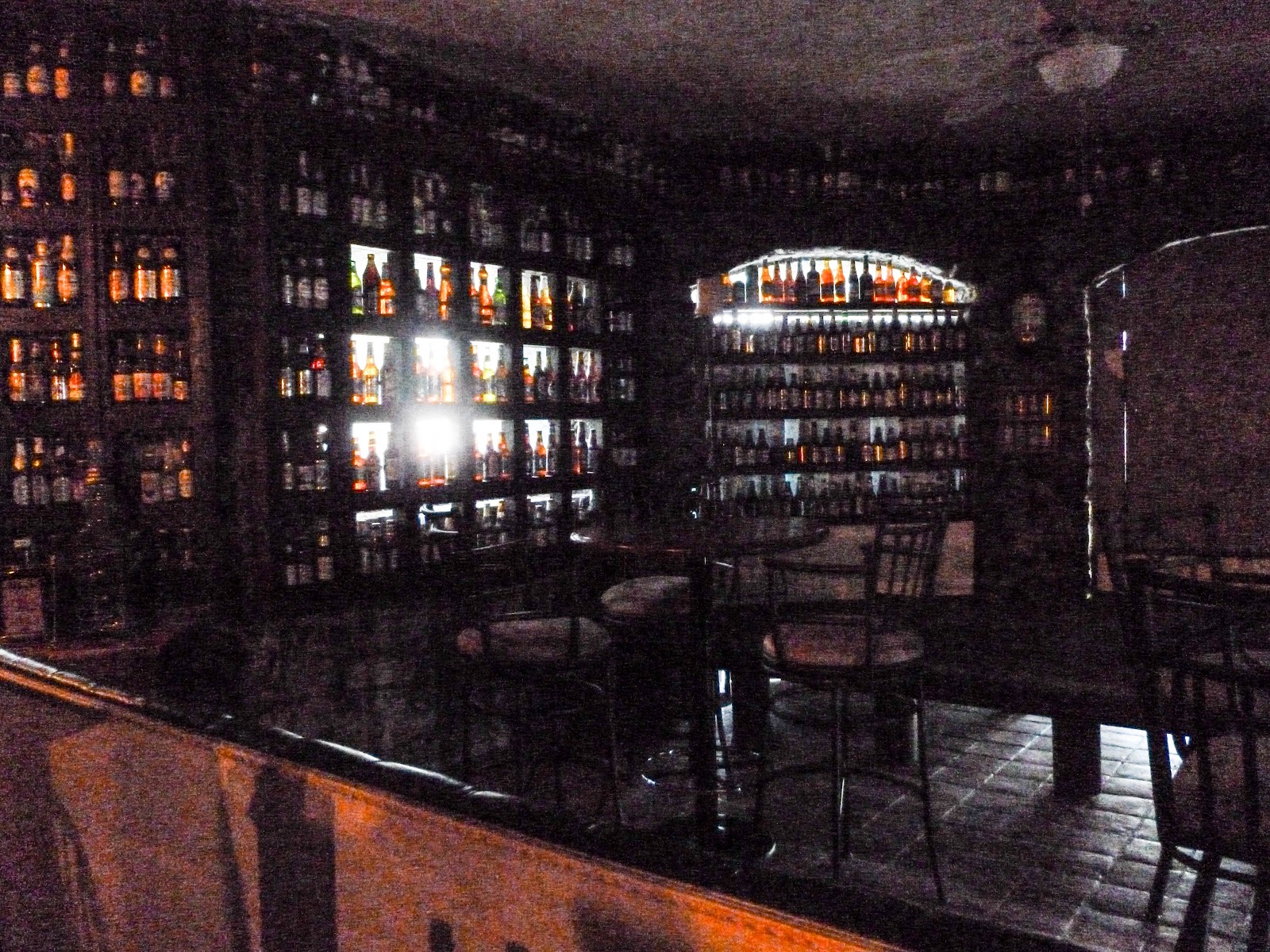
As we left the first floor - there were many more rooms and areas that I didn't photograph, we headed underground, into the tunnels and rooms that had been blasted out of a mountain. Here we could see where John spent 2 years carving into the wall, as well as many bars and wine cellars. Most of the wine bottles were covered with so much dust, the labels couldn't be seen.


This is off the main room - back up bottles, just in case....

underground, inside the mountain


The sculptor and some of his work
That's a big bottle of champagne

Saturday, October 13, 2012

Is it a museum or a home?

I mentioned yesterday that I would try to describe the experience I had on Thursday. I was invited with a small group of other people from San Miguel to go to Juriquilla, a town that is this side of Querétero.

John Osmond, the sculptor, was the tour leader as he worked for 2 years creating work for this place. As we were approaching the town, John pointed out the car window and said, "See the whole town?" That is all owned by one man, my boss."

I did not know what to expect and I am still almost at a loss of words to describe it.


We first stopped at a small park when 3 of John's sculptures are placed.

Next we drove to John's patron's "place" Pictures are going to have to take the place of a lot of words.


A gold leafed carriage from France was the first thing that caught my eye when we walked in the door

The center of the "living" room was filled with geraniums

One of the many book covered tables on the main floor.

A kitchen

Lots of paintings in this room

Antiques

A collection of metal horses

A kitchen sink

Note the candles

John Osmond

The master bath

The dogs each have their own brass bed. This room made me realize that the owner actually lives here. Note the slippers in the background.


Master bath
These photos are a just a sampling of the first floor. I will add more tomorrow as we went deep underground into the rooms that were blasted out of the mountain.

Friday, October 12, 2012

A sculpture brings changes


Sunday, I went to a sculpture reception and fell in love with one of the stone pieces. I came home and walked around my apartment for some time trying to imagine this art in my home. My apartment is not big and I have hundreds of paintings either on the walls or in the stacks awaiting the opening exhibit of my home gallery Sunday, Oct 28. I finally decided with some rearranging, I could create a spot for this powerful sculpture. I called John Osmond and told him I wanted to buy Quetzalcoatl. Yesterday, John installed the sculpture. I think the spot will be right, but time will tell, if Questzacoatl  will fit better somewhere else.

This purchase led to an amazing adventure with a group of people visiting a town about 50 minutes  from San Miguel to see more of John's sculptures. I still am trying to get my mind around what I experienced and I will share it with you soon.


John Osmond is an Australian-born sculptor working and living in the historical mining town of San Miguel de Allende, Guanajuato.
Osmond, who has lived in Mexico for many years, is profoundly influenced by the Mayan culture and the tradition of stone carving still prominent in the culture today. He works with local and regional stone which he carves by hand, occasionally incorporating the use of semi-precious stones. His work is prolific and ranges from a replica of a Mayan pyramid, a Roman Para Nympho and architectural columns to statues, bronzes and other commissioned works located all over Mexico, Australia and the United States.


 Quetzalcoatl (kĕt'sälkôät`əl) [Nahuatl,=feathered serpent], ancient deity and legendary ruler of the Toltec in Mexico. The name is also that of a Toltec ruler, who is credited with the discovery of corn, the arts, science, and the calendar. It is unclear whether the ruler took his name from the god or as a great ruler was revered and later deified.
Quetzalcoatl, god of civilization, was identified with the planet Venus and with the wind; he represented the forces of good and light pitted against those of evil and darkness, which were championed by Tezcatlipoca. According to one epic legend, Quetzalcoatl, deceived by Tezcatlipoca, was driven from Tula, the Toltec capital, and wandered for many years until he reached his homeland, the east coast of Mexico—where he was consumed by divine fire, his ashes turning into birds and his heart becoming the morning star. Another version has him sailing off to a mythical land, leaving behind the promise of his return. Adopting the name, the Aztec
 linked it with the worship of the war god Huitzilopotchtli and applied it to some of their ranking priests. Montezuma
 viewed the Spanish invaders as the returning hosts of Quetzalcoatl. There is a great pyramid in honor of the deity at Cholula
, and the sky-serpent motif in the mosaics at Mitla probably represents Quetzalcoatl. The famous Temple of Quetzalcoatl at Teotihuacán
 is now regarded by some authorities as having been consecrated to a different god.
It is likely that the figure who gave rise to the legendary Quetzalcoatl was an ancestor of his Maya counterpart, Kulkulcán. The Toltec of Tula moved southward, settled in SW Campeche, and in the 10th cent. under the leadership of Kulkulcán, a historical figure, occupied Chichén Itzá
 and founded the cities of Uxmal and Mayapán. Although probably assimilated into the Maya culture by this time, the invaders still employed Mexican architectural motifs (especially the feathered serpent) extensively. After the death of Kulkulcán he became the patron deity of Chichén Itzá, and most of the temples were dedicated to him. The symbol for both Quetzalcoatl and Kulkulcán, the serpent with quetzal feathers, has an obvious connection with serpent worship.

Saturday, October 6, 2012

Black Lace, almost new encasutic painting

Black Lace, 24"x 32", encaustic over oil, India ink and shellac
This seems to be a time of re-working some older paintings. I added more shellac for another burn, giving a lacy feel.

Tuesday, October 2, 2012

Mexican images in encaustic

I am getting
 everything ready for my open house Oct. 28th. That also means pulling older paintings out of the stacks and deciding if they are a hit or a miss. These paintings that I made 6 years ago still had great meaning to me, but they needed more punch, so I reworked them a bit. I have carved into the encaustic as well as adding photos of San Miguel in each painting.

I have been fascinated with the history and culture of Mexico even since I was a teen. Now that I live here I continue to read and absorb even more of this ancient culture.


detail of carving